 Norbert Brett

Never spawn three conversational agents to debate a number that a 40-line Python script can calculate deterministically in two milliseconds.
When Multi-Agent AI Actually Earns Its Complexity
If you have ever watched a demo of four AI agents chatting with each other for five minutes to solve a task that one well-written prompt or a short script could finish in ten seconds, you understand why businesses are cautious about "multi-agent" hype. Months earlier, while prototyping the first version of Founder Suite (my 11-stage business validation pipeline), I was annoyed by the opposite extreme too: when I asked a single AI session to simultaneously act as an enthusiastic product marketer, a skeptical market strategist, and a strict CFO, it averaged all three voices into polite, wishy-washy encouragement.
In Plain English — Single Agent vs. Multi-Agent vs. Deterministic Script:
- Deterministic Script (Python / TypeScript Code): Traditional software rules where
2 + 2always equals4in under a millisecond. Zero guesswork, zero AI token cost.- Single-Agent Mode (
solo): One AI conversation handling a focused task from start to finish—like asking one experienced editor to polish a two-page memo.- Multi-Agent System: Splitting a large job across separate, specialized AI workers that either run at the same time in parallel (like 10 assistants each summarizing one chapter of a book) or check each other's work with fresh eyes.
Across the three AI systems I maintain in production (Gemini Advisor, Book-to-Skill, and Founder Suite), adding multi-agent coordination is only worth the extra complexity when at least one of these three conditions is true:
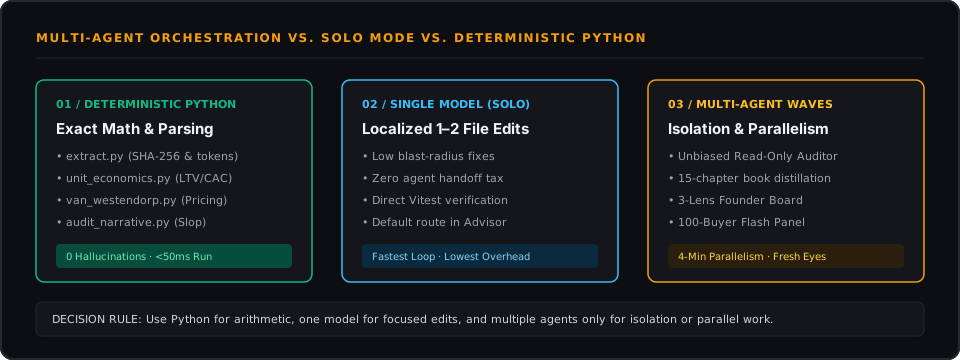
- Fresh Eyes for Quality Control (Context Isolation): In Gemini Advisor, the reviewer agent is launched in a separate session so it never sees the builder's 50,000 tokens of debugging struggle. Because it only inspects the original contract and the final code diff in read-only mode, it catches shortcuts without bias.
- Parallel Speed on Independent Chunks: When Book-to-Skill turns a 500-page technical manual into a modular AI skill, Chapter 2 and Chapter 12 do not depend on each other. Launching parallel waves of fast
Flashsubagents finishes the entire book in under 4 minutes instead of 45 minutes one by one. - Genuine Disagreement Across Different Perspectives: In stage one of Founder Suite (
founder-board), three independent subagents critique a business idea at the same time through three strict, published lenses (Offers, Monopoly, and Product) before their memos are compared. Because they cannot see each other's drafts while writing, they surface real blind spots instead of polite groupthink.
When a Single Model or a Python Script Is the Better Choice
You see, the most expensive mistake in AI engineering today is paying language models to do work that regular code already does perfectly.
When I built Book-to-Skill and Founder Suite, I drew a strict line between qualitative judgment (where AI agents help) and exact calculation (where AI models guess and hallucinate):
Book-to-Skill Pipeline:
  1. scripts/extract.py (Python)          -> Exact PDF/EPUB parsing, SHA-256 fingerprint, chapter token counts
  2. Parallel Flash Subagents             -> Summarize chapter frameworks & decision rules in parallel
  3. tools/scan_generated_skill.py (Py)   -> Deterministic security & copyright-leak check

Founder Validation Suite:
  1. 3x Board Subagents + Flash Buyer Wave -> Surface qualitative positioning & customer objections
  2. van_westendorp.py & unit_economics.py -> Exact price sensitivity bands & break-even unit math
Ask an AI model to calculate profit margins, count exact words in a 200-page PDF, or compute a 36-month cash-flow table, and it will invent numbers that look right but fail on a calculator. I felt relieved the day I stripped every arithmetic question out of our AI prompts and moved them into deterministic Python tools (extract.py, unit_economics.py, and van_westendorp.py).
And for everyday software development, Rule #1 in Gemini Advisor is simple: Default to solo (a single model) for small, low-risk tasks.
| What You Need Done | Best Tool for the Job | Why It Wins |
|---|---|---|
| Financial math, price bands, file hashing, or syntax checks | Deterministic Python / TypeScript Script | 0 hallucinations, runs in <50ms, and gives the exact same answer every time. |
Updating 1–2 files with clear instructions (risk="low") | Single AI Model (solo mode) | No time or money wasted passing messages between multiple agents. |
| Summarizing 15 book chapters or simulating 100 buyer cards | Parallel Flash Subagent Waves | Cuts waiting time from 45 minutes to 4 minutes at low token cost. |
| Multi-file feature or security-sensitive code refactor | Planner -> Builder -> Read-Only Auditor | Locks file boundaries and verifies the final diff with unbiased fresh eyes. |
Working on something similar?
Tell me about it