 Norbert Brett

Using a frontier reasoning model to rename forty CSS variables is like hiring a structural architect to carry drywall up the stairs.
Scoring Task Risk Before Burning Frontier Tokens
Every few weeks, a new AI model launch trends on X and half of the tech timeline declares that model routing is obsolete because the newest flagship model can do everything. Then you actually run that flagship model across a 60-file software project, watch it spend 90 seconds "thinking" just to add a button style, and hit your usage quota before lunch. Months earlier, I was frustrated by that exact trap: I was burning my most expensive, highest-latency reasoning model on repetitive formatting tasks, leaving zero capacity for the database and security decisions that actually required deep thought.
In Plain English — What is "Selective Model Routing"? AI models come in different sizes and speeds, much like vehicles in a logistics fleet:
- Frontier Reasoning Models (e.g.,
Gemini Pro / Argon): Like a senior structural engineer—capable of weighing complex trade-offs across an entire building blueprint, but slower and 10–30x more expensive per page.- Fast Execution Models (e.g.,
Gemini Flash / Flash-Lite): Like a skilled, high-speed installation crew—once you hand them an exact blueprint and measurements, they execute the work in seconds at a fraction of the cost.- Selective Model Routing: Automatically choosing which model handles each step based on how ambiguous and how risky the task is.
When I built the dynamic routing engine in Gemini Advisor (scripts/model_allocator.sh), I made risk scoring mandatory before any file is edited:
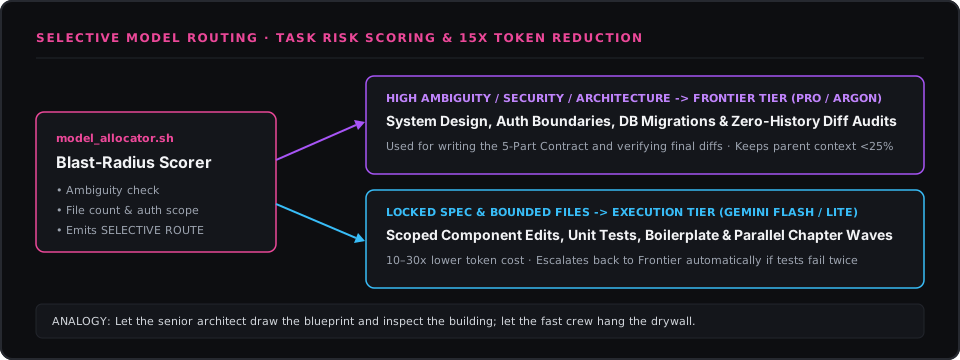
# Dynamic tier check before modifying workspace files
./scripts/model_allocator.sh --check
# Emits: SELECTIVE ROUTE mode="solo|delegate|audit|full" risk="low|medium|high"
You see, the dividing line between tasks that require a Frontier reasoning model and tasks that run better on a fast execution model comes down to two questions: Is the design still ambiguous? and What is the blast radius if a mistake happens?
| Decision Factor | Use Frontier Tier (Pro / Architect) | Use Execution Tier (Flash / Builder) |
|---|---|---|
| Clarity of Spec | Requirements are open-ended; several different designs could work. | File paths, data types, and rules are already locked in a written spec. |
| Blast Radius (Risk) | Touches login security, payment logic, database schemas, or shared routing. | Confined to 1–3 specific UI components, test files, or content pages. |
| Cross-File Context | Must connect dots across 15+ files or audit a finished diff for subtle bugs. | Only needs to read the target file and the 5-part implementation contract. |
| Cost of an Error | Silent data leak, broken customer checkout, or security hole. | Immediate compiler or test error that gets caught and fixed in 3 seconds. |
Measuring the Trade-Off: Why Fast Models Need a 5-Part Contract
If you give a fast execution model a vague five-word prompt like "Add rate limiting to the contact form," it will guess—and you will spend an hour cleaning up its assumptions. If you have ever blamed a faster model for "bad code" after giving it a one-sentence instruction, the model was not the problem; the missing blueprint was.
In my workflow across Gemini Advisor and the Book-to-Skill distiller, the Frontier model never disappears—it just stops typing out 400 lines of repetitive implementation code. Instead, it writes the 5-Part Contract (exact data shapes, allowed files, forbidden shortcuts, and test commands) and hands that blueprint to a Flash builder subagent.
When we measured this split across 20 real feature and refactoring tasks in 2026, three numbers proved the trade-off:
- 15x Reduction in Frontier Token Usage: Because trial-and-error compiler fixes happen inside the cheap, disposable
Flashbuilder session instead of cluttering the main architect's memory, parent context usage stayed below 25%. - 4-Minute Parallel Processing: In Book-to-Skill, after a deterministic Python script (
extract.py) calculates exact chapter byte offsets, parallel waves ofFlashsubagents distill a 500-page technical manual into structured agent skills in under 4 minutes. - Automatic Safety Escalation: If a
Flashbuilder fails the automated test suite twice or hits an unexpected schema conflict, the router automatically escalates back to the Frontier model rather than letting the fast model guess.
I felt relieved once I stopped asking "Which single AI model is best on social media?" and started measuring verified cost per merged feature. Use your deepest reasoning model to lock the blueprint and inspect the result, and let the fast model do the heavy typing in between.
Working on something similar?
Tell me about it